Paper decoded · Tungsten and tin
Tungsten and tin fertility begins with different crustal sources
Xia et al. link regional W-Sn zonation to contrasting metasedimentary sources and melting conditions, then show how emplacement and differentiation modify that inherited metal fertility.
01
Why this matters
Tungsten (W) and tin (Sn) are economically and strategically important metals associated with evolved, commonly reduced granitic systems. However, some major W-Sn metallogenic provinces show a distinct spatial separation between W and Sn deposits. South China's Nanling belt is one example: Late Jurassic W deposits dominate the eastern domain, whereas most coeval Sn deposits occur in the west. Explaining this separation matters for exploration because a highly fractionated granite is not a unique indicator of either metal.
Previous models have explained this distribution through contrasting fluid behaviour, variable mantle input, or sequential low- and high-temperature melting of a broadly similar crustal source. Xia et al. (2026) instead test whether the granite magmas originated from different metasedimentary sources and whether these differences persisted through melting, emplacement and differentiation.
02
What the study found
The authors compiled whole-rock data from mineralisation-associated Mesozoic granites across Nanling and modelled fluid-absent melting of representative basement pelite and greywacke at 8 kbar.
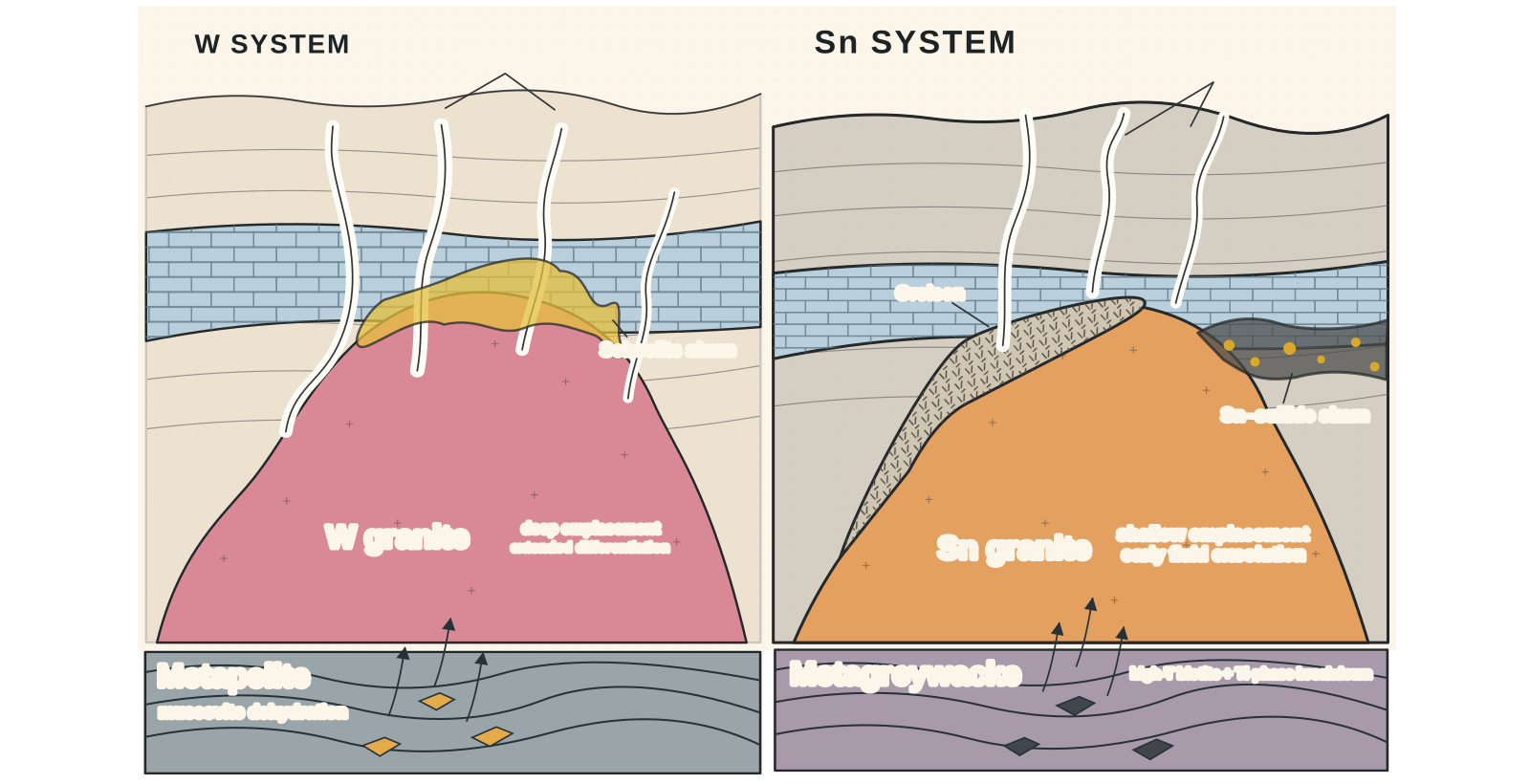
W- and Sn-related granites show contrasting geochemical signatures. Vein-related W granites generally have low CaO/Na2O, MgO, TiO2 and F, but high Rb/Sr and Rb/Ba, consistent with clay-rich metapelitic sources. In contrast, Sn-related granites retain higher CaO/Na2O, MgO, TiO2 and F and are interpreted to derive mainly from sandstone-rich metagreywacke.
Phase-equilibrium modelling shows how source mineralogy and melting conditions influence metal fertility. Muscovite dehydration in pelite at approximately 690-750°C produces enough melt to mobilise W efficiently, generating liquids containing up to approximately 20-21 ppm W. In contrast, Sn in greywacke is hosted mainly in biotite and refractory Ti-bearing minerals. Temperatures above approximately 850°C and more extensive melting are therefore required to produce extractable Sn-rich melt containing up to approximately 18 ppm Sn. W- and Sn-rich magmas can thus form directly from contrasting sources and melting reactions, without requiring earlier extraction of a W-rich melt from the greywacke.
The W- and Sn-rich magmas also evolved differently after leaving their sources. W granites record more extensive differentiation and melt-fluid interaction than Sn granites, as indicated by lower Zr/Hf, Nb/Ta, Th/U and LREE/HREE ratios. Biotite barometry further suggests that W granites crystallised at greater pressures, commonly above 4 kbar. Xia et al. infer that the shallower Sn granites cooled more rapidly than the deeper W granites.
The proposed divergence of W and Sn during the magmatic-hydrothermal transition remains uncertain because the whole-rock trends are scattered and combine different plutons.
03
Our interpretation
The paper's strongest contribution is its separation of source fertility from later metal concentration. Metapelite and metagreywacke are not interchangeable sedimentary sources undergoing different degrees of the same melting process. They contain different mineral hosts for W and Sn, undergo different dehydration reactions and produce different melt volumes and metal ratios. Source composition establishes the direction of fertility, while melting temperature and degree determine whether enough of that metal enters an extractable melt.
The relative importance of source and fractionation is scale dependent. At the regional scale, basement composition and melting conditions most directly explain the east-west W-Sn division. Fractionation and fluid exsolution cannot generate a W- or Sn-rich system unless the relevant metal is first released effectively from the source. At district and deposit scales, however, source fertility alone is insufficient. The Triassic W granites provide the paper's clearest internal test: they share a broadly pelitic source with the more productive Late Jurassic W granites, but experienced less partial melting and weaker differentiation and are associated with much smaller deposits. Fertility must therefore be activated, transferred and focused.
Emplacement depth connects this source control with subsequent magmatic-hydrothermal evolution. Xia et al. propose that deeper W magmas cooled more slowly and underwent more extensive crystallisation and melt-fluid interaction, whereas shallower Sn magmas cooled faster and exsolved fluid earlier. However, the inferred degree of fractionation does not correlate consistently with the tonnage or grade of the regional W and Sn deposits.
A further uncertainty lies in the deeper history of the source. The metasedimentary basement formed from a broad Neoproterozoic-Ordovician succession that was metamorphosed during early Paleozoic orogenesis and remelted during Late Jurassic extension. A flysch or turbidite system could plausibly contain mud-rich and greywacke-rich domains, but the paper does not reconstruct basin architecture, depositional ages or provenance. The eastern and western sources may therefore represent different facies, stratigraphic packages or assembled terranes. This uncertainty does not invalidate the melting model, but the ultimate origin of the source heterogeneity remains unresolved.
04
Exploration and mining implications
At the regional scale, exploration should map crustal source domains before treating evolved granites as a single prospective class. Clay-rich basement with low CaO/Na2O, high Rb/Sr and Rb/Ba, and evidence of muscovite-rich metapelite strengthens the case for W fertility. Sandstone-rich basement, metagreywacke signatures, high-temperature biotite breakdown and nearby evidence of mantle-derived heating strengthen the case for Sn fertility. In western Nanling, the Chenzhou-Linwu fault may have acted both as a magma pathway and as a conduit for mantle-derived heat capable of driving higher-temperature melting.
At the district scale, source indicators should be combined with evidence for emplacement and differentiation. Low Zr/Hf, Nb/Ta and Th/U ratios and a strong REE tetrad effect indicate advanced evolution and melt-fluid interaction, which the study associates particularly with W systems. These indicators are not unique ore vectors and may be inherited or modified by alteration, so source interpretation should prioritise the least evolved and least altered granite phases. Estimated emplacement pressure, cooling history, pluton geometry and evidence of fluid saturation may help distinguish deeply emplaced, more extensively evolved W systems from shallower Sn systems.
Mineralisation style determines the relevant host rocks and vectoring criteria. Exploration for wolframite should follow evolved granite cupolas, intrusive contacts, faults and quartz-vein corridors. Scheelite targeting requires carbonate-bearing wall rocks and evidence of skarn-forming fluid-rock reaction; carbonate assimilation may also obscure source-sensitive granite ratios. Cassiterite exploration should target greisen zones and quartz veins within and above granite cupolas, as well as apical intrusive contacts where skarn-replacement or cassiterite-sulfide bodies may extend into surrounding rocks. Structural permeability, fluid pathways, alteration zoning and paragenesis must therefore be reconstructed independently of whole-rock indicators of granite fertility.
W- and Sn-rich granites are the magma sources and fluid engines of these systems, but they are not necessarily the physical hosts of the ore.
Three things to carry into the field
Nanling W- and Sn-related granites inherited different metasedimentary sources and melting histories.
Map the complete source-to-ore system: source, melting regime, emplacement, fluid pathways and reactive hosts.
The study models metal release into melt more directly than hydrothermal ore deposition.
References
Xia, L., Yu, J.-H., Zhou, M.-F., & Zhang, R. (2026). The zonal distribution of W- and Sn-mineralized granites in the Nanling metallogenic belt, South China: The role of magma sources and differentiation. Economic Geology. https://doi.org/10.5382/econgeo.5252