Paper decoded · Porphyry-related alteration
Reading Patchy and Nodular Alteration as a Porphyry Vector
High sulfidation alteration can expose the shallow part of a much larger magmatic-hydrothermal system, while the causative porphyry remains concealed or laterally offset.
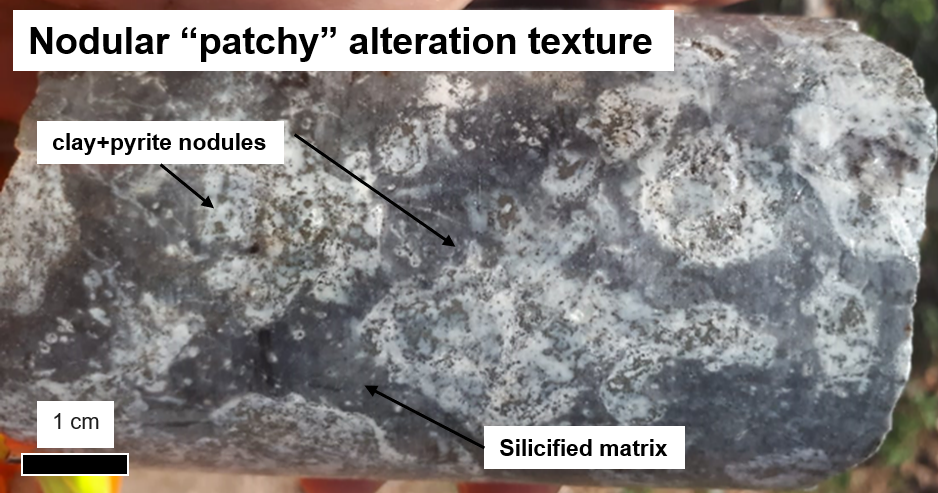
Patchy (or nodular) alteration consists of discrete, commonly rounded to lobate domains of pyrophyllite ± other advanced argillic minerals (alunite, dickite, etc.) replacing silicified domains (i.e. quartz) and white mica in a siliceous host rock.
01
Why it matters
High sulfidation alteration can expose the shallow part of a much larger magmatic-hydrothermal system, while the causative porphyry remains concealed or laterally offset. Recognising textures that form near the base of a lithocap can help distinguish a potentially proximal porphyry-related environment from a broad, weakly constrained advanced argillic footprint.
02
What the study found
Halloran et al. (2026) interpret nodular pyrophyllite-rich alteration as a replacement texture developed where pyrophyllite replaces earlier muscovite and quartz. Their petrographic evidence includes embayed and cuspate quartz margins, supporting dissolution of quartz as the reaction proceeds. Because pyrophyllite contains more silica relative to aluminium than muscovite, the replacement reaction requires silica; quartz is consumed as pyrophyllite forms, and local silica released or redistributed during later reactions can produce silicified margins.
The assemblage records cooling through a temperature range in which muscovite-bearing alteration gives way to pyrophyllite, with diaspore, dickite/kaolinite, alunite and pyrite occurring variably. In the studied system, the nodular zone maps a shallow palaeothermal envelope above porphyry intrusions. The authors’ key exploration point is that this texture can mark the basal, hotter part of a lithocap and provide a vector towards a concealed porphyry centre.
The paper also clarifies a terminology problem. “Patchy” has been used for nodular pyrophyllite replacement, whereas “wormy” or gusano commonly describes elongate, connected features that follow veins or structures. Nodular features may be discrete and unconnected. These labels are not interchangeable, and similar-looking patches can instead be primary fragments, silicification, or another alteration overprint. Mineral identification and cross-cutting relations are essential.
Muscovite and quartz form the earlier alteration assemblage.
03
What the textures mean for targeting
From a new target, patchy or wormy-looking exposures are a reason to investigate, not yet a porphyry diagnosis. First establish whether the pale domains are replacement products and identify their minerals using petrography and, where useful, shortwave infrared spectroscopy or X-ray diffraction. A combination of pyrophyllite with relic or relict-textured white mica, corroded quartz, and locally diaspore, alunite or pyrite is more informative than colour or geometry alone. Map whether the features are isolated nodules, connected worm-like bodies, or aligned along veins and structures; each geometry implies different controls on fluid access and nucleation.
Where a high sulfidation system is already recognised, a pyrophyllite-rich replacement zone near the base of the lithocap may indicate the hotter transition towards the intrusive roots. Track its vertical and lateral mineralogical changes, structural pathways, intrusive and breccia relationships, and evidence for overprinting. The main target may lie below the texture or to one side: lithocap alteration can be displaced from the causative intrusion, and erosion, palaeotopography, host-rock composition, fault movement and repeated hydrothermal pulses can distort the original geometry (Sillitoe, 2010; Hedenquist and Arribas, 2022).
The vector is strongest when the texture, replacement mineralogy and regional alteration pattern agree. It is not a grade indicator and should be integrated with geochemistry, geophysics, structure and drilling. Nodular pyrophyllite may be absent where the host rock lacks suitable silica or nucleation sites, so its absence does not rule out a porphyry system.
References
Halloran, J., Hedenquist, J.W., Hattori, K. and Godoy, T. (2026). Nodular pyrophyllite replacement of muscovite-quartz reflects paleo-isotherms over the Valeriano porphyry intrusions and Cu-Au-Mo deposit, Chile. Mineralium Deposita, 61, 1585-1594. https://doi.org/10.1007/s00126-026-01445-4
Hedenquist, J.W. and Arribas, A. (2022). Exploration implications of multiple formation environments of advanced argillic minerals. Economic Geology, 117, 609-643. https://doi.org/10.5382/econgeo.4880
Sillitoe, R.H. (2010). Porphyry copper systems. Economic Geology, 105, 3-41. https://doi.org/10.2113/gsecongeo.105.1.3