Paper decoded · Porphyry copper
Copper mineralization formed early and hot
Late low-temperature quartz can sit against copper sulfides without having deposited them—a distinction that changes how porphyry vein histories are reconstructed.
01
Why this matters
Knowing when copper (Cu) and molybdenum (Mo) precipitated is fundamental to understanding and exploring porphyry systems. Yet an important ambiguity arises at the grain scale: Cu-Fe sulfides are commonly associated with late quartz veins, which are interpreted to form at moderate temperatures. Does that contact record Cu deposition at approximately 300–450°C, or did later quartz simply exploit fractures around older sulfides?
Cernuschi et al. (2023) revisit this problem by integrating microscopic textures with vein crosscutting relationships, alteration mineralogy and experimental constraints. Their central question is not merely when a quartz generation formed, but whether the quartz and adjacent sulfides were actually coeval. Resolving that distinction affects estimates of ore-forming temperature, the interpretation of vein sequences and the way drill-core observations are placed within a deposit-scale model.
02
What the study found
The authors examined Haquira East, Encuentro and Batu Hijau porphyry systems. They combined scanning electron microscopy cathodoluminescence (SEM-CL), QEMSCAN mineral mapping, conventional petrography and alteration phase relationships.
Across all three deposits, younger, typically dull-luminescing quartz fills microfractures that cut every older generation of high-temperature quartz. The sulfides associated with those microfractures depend on the material being crosscut. The authors therefore argue that contact between dull-CL quartz and a sulfide does not, by itself, demonstrate that they precipitated together.
Their preferred model places most Cu-Fe sulfide precipitation above approximately 450°C, during K-silicate alteration. Much of the molybdenum was introduced in later, discrete high-temperature molybdenite-quartz veins. Later fluids formed C and D veins and dull-CL quartz at about 300–450°C, introducing minor additional Cu and locally dissolving, remobilizing and reprecipitating earlier sulfides.
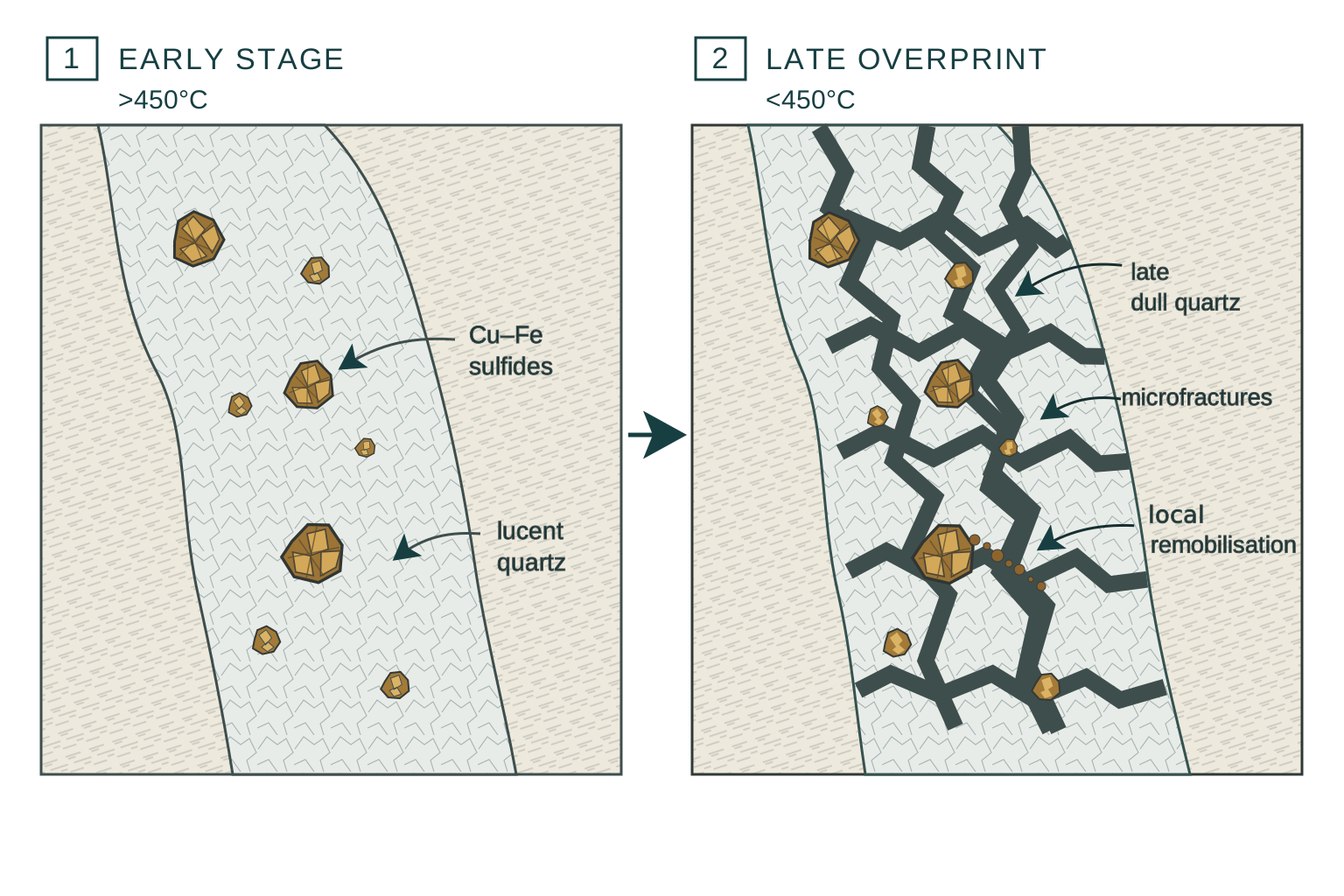
Cu–Fe sulfides precipitate with early lucent quartz during K-silicate alteration at temperatures above approximately 450°C.
03
Our interpretation
The paper’s most important contribution is methodological: mineral contact is not equivalent to mineral co-precipitation. A late fracture network can repeatedly reopen older quartz-sulfide boundaries and create textures that appear genetically linked when viewed without the full paragenetic and spatial context.
The depth-dependent comparison is equally useful. It explains why Cu-rich stages may be quartz-rich in shallow A-vein-dominated systems but quartz-poor in deeper early-halo systems. Retrograde quartz solubility can inhibit quartz precipitation during deep fluid ascent even while Cu is deposited. Quartz abundance is therefore not a simple proxy for either fluid flux or Cu introduction.
This interpretation is persuasive because the same late dull-CL microfracture network cuts Cu-bearing, Mo-bearing and barren quartz populations. Nevertheless, it is a genetic framework rather than a universal temperature calibration. Application elsewhere requires local paragenetic control.
04
Exploration and mining implications
For exploration teams, the practical lesson is to reconstruct sequence before assigning significance to a mineral contact. Vein type, alteration halo, crosscutting relationship and deposit position should be logged together. Late quartz veins in apparent contact with chalcopyrite may record late reopening and local remobilization—not a new, deposit-scale Cu event.
The model also provides depth-sensitive expectations. In shallower porphyry environments, early Cu may be concentrated in abundant A veins with K-silicate alteration. In deeper exposures, comparable Cu introduction may occur in quartz-poor early halos, whereas still deeper quartz-rich veins can belong to a low-grade or barren core. Quartz-vein abundance alone should not be used to rank porphyry fertility or proximity to ore.
SEM-CL and automated mineral mapping are most valuable when applied selectively to representative vein generations anchored by core-scale logging. Their role is to test paragenesis and identify reopening or dissolution—not to replace field relationships.
Three things to carry into the field
Most Cu-Fe sulfides were introduced during early, >450°C K-silicate alteration.
Interpret contacts within a documented vein and alteration sequence—not in isolation.
CL brightness and grain-scale contacts are not standalone timing or temperature indicators.
Reference
Cernuschi, F., Dilles, J.H., Osorio, J., Proffett, J.M., and Kouzmanov, K. (2023). A reevaluation of the timing and temperature of copper and molybdenum precipitation in porphyry deposits. Economic Geology, 118(5), 931–965.